Bike Share for Apartments in Charlotte: Condos & Multifamily Properties
Charlotte’s [Future 2040 plan](https://cltfuture2040plan.com/policy-framework/goal-1-10-minute-neighborhoods/) calls for essential daily needs to be reachable by a comfortable, tree-shaded walk, bike, or transit trip. For owners planning bike share for apartments in Charlotte, that goal suggests a concrete design choice: place pickup space near the resident exit serving everyday errands, rather than wherever unused storage remains. Treat shade and access as part of the amenity layout. The plan describes a future access goal, not a bike-share requirement or proof of current connections.
Compare current Charlotte public service separately
For a manager comparing an on-site amenity with nearby public service, historical availability is not a substitute for checking where residents can pick up and return a bike today. Confirm the public operator’s current service area, bicycle types, and return rules before describing that option to residents.
Separate documented infrastructure from building access
Before promoting a trail or transit connection, document the named destination, access point, crossings, route continuity, and return arrangements. For a transit trip, also verify where the bicycle may be left. Proximity to a station does not establish permission to return a property bicycle there.
Keep two records distinct: source documentation establishing what infrastructure exists, and an address-level inspection establishing how residents would reach it. A municipal project description does not confirm that every segment between a building and a destination is complete or suitable for residents.
Storage, terrain, and access checks for a residential fleet
For the property assessment, inspect sheltered storage, exposure at the pickup area, drainage, and slopes along intended routes. Because Property Pedal supplies standard non-electric bicycles, evaluate the complete trip without assuming electric assistance.
Review enrollment, app requirements, resident instructions, and access to the bicycles as part of the property proposal.
Multifamily amenities in Charlotte: decisions for design, lease-up, and condo review
Establish the property case before forecasting benefits
A proposal should explain the intended resident trips and management arrangements without promising higher rents, faster absorption, or improved retention.
For new construction, identify pickup and return space before finalizing circulation and storage layouts. For an existing community, inspect the racks and the path from storage to the street. For condo boards, request a written scope covering upkeep, resident onboarding, operating responsibilities, and costs before a vote.
Keep compliance separate from amenity planning
Do not assume that supplying shared bicycles satisfies a development requirement or that a municipal rack program applies to a particular residential property.
Public bike share versus a private Charlotte property fleet
Compare the trip each model supports
A private residential fleet needs a property-specific definition of access, pickup locations, and permitted returns. Do not assume that it supports one-way trips to a transit station. Return rules and destination parking must be checked separately.
Compare responsibilities, not labels
Ask who maintains the bicycles, handles unavailable bikes, manages access, and resolves parking problems. Property Pedal’s fully managed program includes fleet sizing, installation, property branding, resident app setup, and ongoing upkeep. Property Pedal arranges a local mechanic for ongoing maintenance rather than assigning routine bicycle maintenance to the on-site team.
A nearby public service might suit trips outside the property, while an on-site fleet might suit trips beginning and ending at the building. Neither is universally preferable. Evaluate the actual network and proposed operating scope.
Internal review hold: image approval outstanding
Draft remains on image hold. Do not publish until the image issue is resolved and the page is approved.
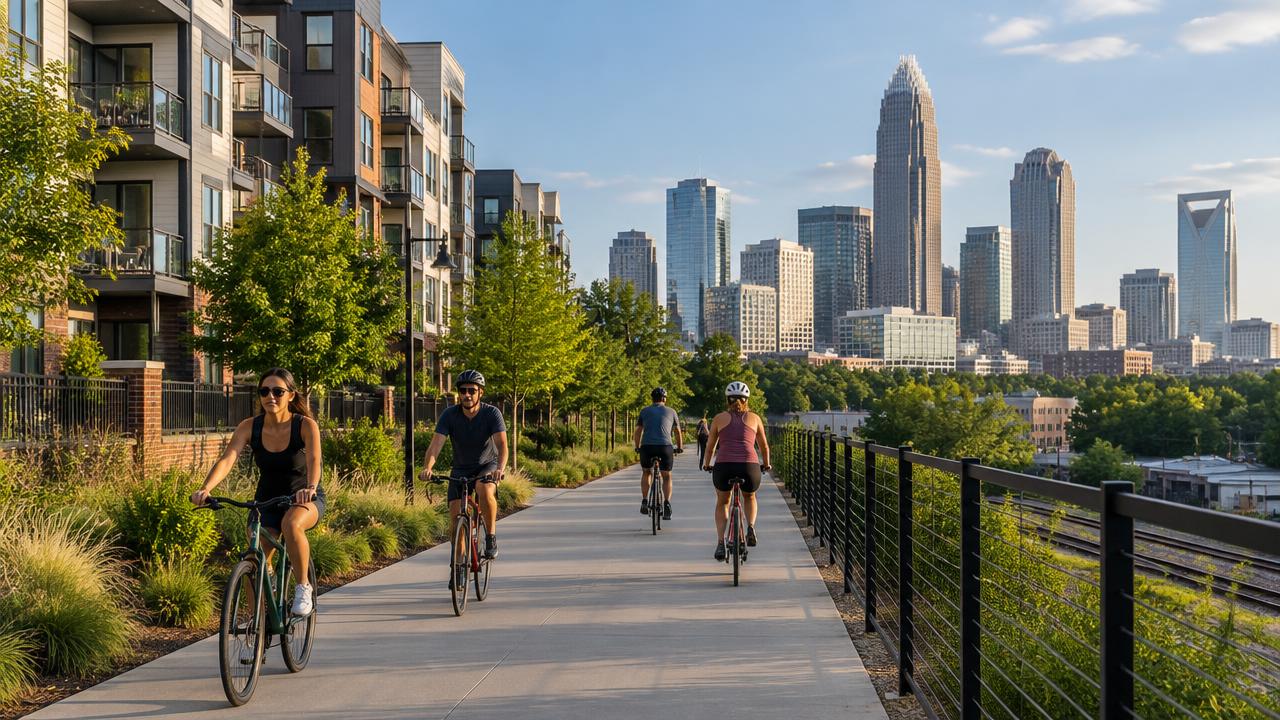
Photo: The research packet includes image URLs and source descriptions, but no approved publication asset or usage permission. Supply an approved Charlotte photograph with usage permission. It can then be embedded in an existing section without changing the JSON shape, with alt text and a caption describing the actual image. The current hero fields remain internal hold notices, not image descriptions.
Neighborhoods and opening: Replaced the generic assessment entries with sourced South End, Uptown, and West Sugar Creek entries. South End and Uptown each name a documented destination and identify a building-to-destination access consideration. The opening now connects Charlotte’s tree-shaded daily-access planning goal to pickup-space placement. These revisions remain subject to QA approval.
Source scope: Removed citations outside the allowed research packet and replaced the unsupported municipal reference with the City’s Urban Arboretum Trail description. No source establishes address-level access, current public fleet coverage, or local Property Pedal installations.
Planning a Property Pedal bike share for Charlotte apartments and condos
Property Pedal is a reseller of Koloni and offers fully managed residential programs covering fleet sizing, installation, property branding, the resident app, and ongoing upkeep. Its bicycles are standard non-electric models.
Designated pickup and return spaces can be geofenced to suit the property. Suitable existing racks can often be reused, potentially reducing costs without requiring proprietary docks. Returns are not leave-anywhere, and the rider’s phone location is tracked during rides.
For a Charlotte proposal, bring the property address, site plan, rack photos, and intended resident destinations. Request a quote for a property-specific assessment. A proposal is not evidence of an existing local installation or a guaranteed property outcome.
Sources and further reading
- 1.Goal 1: 10-Minute Neighborhoods, Charlotte Future 2040
- 2.Charlotte Urban Arboretum Trail, City of Charlotte
- 3.North Carolina’s Charlotte Rail Trail, Rails-to-Trails Conservancy
- 4.Walkable Neighborhoods in Charlotte, NC: Where to Stay, The Home Collection
- 5.Achieving 10-minute Neighborhoods in Charlotte’s Corridors of Opportunity, CHARP
Charlotte neighborhoods Property Pedal serves
South End
For a South End building considering trips to the Charlotte Rail Trail and its trailside restaurants, documented by [Rails-to-Trails Conservancy](https://www.railstotrails.org/trailblog/north-carolinas-charlotte-rail-trail/), inspect the path from bike storage to the actual trail entrance, including intervening crossings, before choosing pickup space.
Uptown
Romare Bearden Park is an Uptown destination identified by [The Home Collection’s neighborhood guide](https://www.thehomecollectionclt.com/blog/thehomecollection_20261005_walkable-neighborhoods-charlotte-nc-where-to-stay_0d7058); a building proposing park trips should check the street crossings between its resident exit and the park, along with destination bike parking, rather than treating the district’s compact grid as proof of a suitable cycling connection.
West Sugar Creek corridor
In West Sugar Creek, where [CHARP researchers interviewed residents about transportation and access to daily resources](https://charp.charlotte.edu/charp-projects-and-partners/10-minute-neighborhoods/), ask residents which grocery or other everyday trip matters before selecting a fleet, then inspect that building-to-destination connection rather than assuming the city’s access goal has already been met.
Built for Charlotte multifamily teams
Property Pedal serves apartment and regional managers, multifamily owners and developers, and condo and HOA boards. Its fully managed scope covers fleet sizing, installation, property branding, resident app setup, and ongoing upkeep, so on-site teams do not take on routine bike maintenance.
Cypress Group: Two-Asset Condo HOA
How a condo board added a modern mobility amenity without raising HOA dues meaningfully.
Frequently asked questions
How should we evaluate bike share for apartments in Charlotte?+
Separate the public infrastructure context from the proposed residential service. Ask which facilities are documented as complete, where property bikes may be picked up and returned, and who handles upkeep. Confirm building access through a site assessment before describing a trail or transit connection to residents.
Does Charlotte’s public bike-share history prove residents will use a private fleet?+
No. Public-system history and citywide ridership do not establish demand at an individual apartment or condo building. Neither should become a forecast of occupancy, renewals, or private-fleet usage.
What should a Charlotte condo board verify about current public bike share?+
Verify the current operator, service area, nearby pickup locations, bicycle types, and return rules before comparing alternatives. Do not assume that an older station reference means a service remains available. Any public e-bike offering is a separate system from Property Pedal’s standard non-electric fleet.
Can a Charlotte condo bike share amenity use existing racks?+
Property Pedal can often reuse suitable existing racks, which may reduce setup costs, but suitability requires an assessment. Designated pickup and return spaces can be geofenced. The program does not require proprietary docks or allow leave-anywhere returns.
Are Property Pedal bikes electric, and how is ride location tracked?+
Property Pedal supplies standard non-electric bicycles, so its fleet does not require battery charging. The rider’s phone location is tracked while riding.
Bring branded bike share to your Charlotte property.
Tell us about your community and we'll send a custom proposal within one business day.