Bike Share for Apartments in Kansas City, Condos & Multifamily Properties
Kansas City’s bikeways planning distinguishes future improvements from routes residents can use today. Evaluating bike share for apartments in Kansas City starts with that distinction: check the streets and trails reachable from the building before choosing a fleet. The city describes its plan as high-level guidance, with detailed design handled corridor by corridor ([city plan](https://www.kcmo.gov/city-hall/departments/bikeways-trails-plan)).
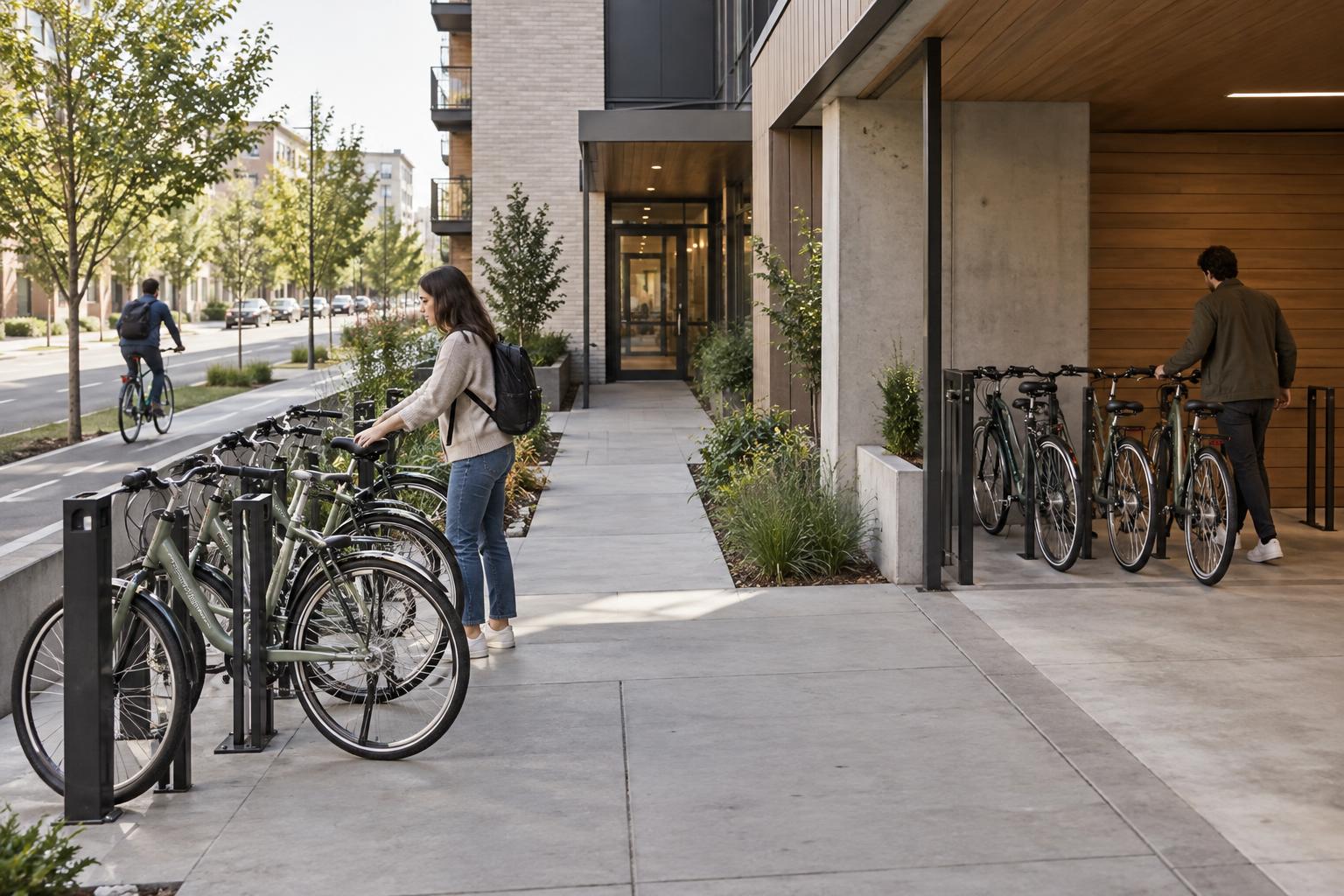
Kansas City bikeways planning: what a property proposal can rely on
Separate proposed connections from existing routes
Kansas City describes its Bikeways and Trails Plan as guidance for future infrastructure. Do not treat a planning document as confirmation that residents can already reach a trail or destination from the property.
The city’s matching source excerpt states: “Detailed planning and design will be done on a corridor-by-corridor basis when specific corridors are ready for implementation.” It also states: “The plan will be implemented incrementally as opportunities for improvement are identified.” Source: Kansas City Bikeways & Trails Plan.
For an owner reviewing an amenity proposal, separate the routes available now from improvements that may become useful later. Size the initial program around verified trips rather than future network assumptions.
Kansas City route selection: separation, crossings, and resident access
Check the type of route, not just the line on a map
MARC distinguishes separated bike lanes from marked bike routes. Its definition of a separated bike lane is: “A bike lane (sometimes called a mobility lane) that is separated from automobile lanes by parked cars, curbs, bollards and/or other delineators.” Its definition of a marked bike route is: “Streets with bike route signage or shared lane markings (sharrows) indicating a preferred route for bicycles.” Source: MARC Regional Trails & Bikeways Map.
That distinction matters when preparing resident directions. Do not describe a marked route as physically separated from traffic. Inspect the route from the property entrance, including the crossings between mapped segments.
For a building proposal, separate three questions: whether residents can access the program, whether they can comfortably complete useful trips, and whether the operating budget supports upkeep. A strong answer to one does not resolve the others.
Brush Creek, Blue River, and West Bottoms siting checks
Brush Creek and Blue River trails: investigate the connection
The supplied local public-post excerpt states: “Check out the beautiful Brush Creek and Blue River trails for commutes any time.” This supports naming the trails as local commuting references, not promising year-round conditions or a verified itinerary from an apartment entrance. Source: Kansas City trail post.
Before adding either trail to resident guidance, verify the intended entrance, surface, crossings, and return approach. A bicycle available at the building does not automatically support a one-way trip. If the program requires a return to the property, explain that limitation rather than implying residents can leave a bicycle at their destination.
West Bottoms: inspect the junctions
KCTV’s supplied image caption identifies an “Unmarked traffic island near Forrester and Bluff Road in the West Bottoms.” That documents the setting discussed in the report, not the junction’s current condition or a designated cycling route. Source: KCTV.
For a nearby property, inspect current signs, visibility, and the approach residents would actually use. Do not turn a historical road report into either a present-day safety assurance or a claim that the entire neighborhood is unsuitable for riding.
Kansas City apartment bike routes: safety, weather, and resident access
Inspect the trip beyond the property line
Ask residents where they want to ride, then inspect the route rather than relying only on map distance.
For each proposed trip, review driveway exits, intersections, pavement, lighting, and the return approach. Check whether a resident can get from the bicycle storage area to the street without an awkward stairway or vehicle conflict. These are recommended site checks, not claims that a particular Kansas City route has been audited.
Plan for weather without promising a riding season
Include weather decisions in the operating plan: where bicycles will be stored, how conditions will be checked, when riding should be discouraged, and how residents will receive notices. Obtain local climate evidence and site-specific advice before setting seasonal availability expectations. Standard bicycles also require a route review that does not assume electric assistance on grades.
Test access as well as interest
Ask prospective participants about app access, onboarding, confidence, and intended trips. Keep other mobility options visible for residents who cannot or do not want to ride.
Public bike share versus a Kansas City residential fleet
Compare the trip each option can support
Evaluate any public service available near the address separately from a property-level program. Do not assume identical service boundaries, return rules, or vehicle capabilities.
| Decision | Public-system review | Property-fleet review |
|---|---|---|
| Pickup access | Confirm current locations and availability near the address. | Choose an accessible location within the property. |
| Return options | Verify the public operator’s current rules and service area. | Define designated returns and explain whether trips must end at the building. |
| Bicycle type | Check what vehicles are actually offered locally. | Assess likely routes for standard non-electric bicycles. |
| Operations | Understand what the public operator provides and what the property does not control. | Document installation, upkeep, resident instructions, and issue handling. |
| Evaluation | Assess actual convenience for the building’s residents. | Assess participation, useful trips, and operating demands at the property. |
Neither model wins at every address
A nearby public option may make a separate fleet unnecessary for some buildings. A private fleet may be worth evaluating where property-based pickup and clearly defined returns suit resident trips. Neither conclusion follows from citywide ridership alone.
Planning a Kansas City multifamily bike amenity before procurement
For owners and lease-up teams
Define the resident use case before selecting a fleet: recreation, errands, or another trip verified from the address. Do not assume a leasing premium or a particular level of resident demand without building-specific evidence.
Document the intended pickup area, likely routes, return expectations, resident-access process, and operating responsibilities. Set evaluation criteria around the proposed program rather than importing public ridership as a forecast. Regional use does not demonstrate building-level occupancy or retention effects.
For architects and construction managers
Review the path from storage to the street, space around racks, pedestrian circulation, and maintenance access. Coordinate these decisions before finalizing the amenity area. Use MARC’s route classifications to guide further investigation, not as confirmation of a completed connection to the property. Source: MARC.
For condo and HOA boards
Request a clear description of ongoing responsibilities, costs, resident rules, and how operating problems will be addressed. Review liability and insurance with the appropriate advisers rather than assuming a managed service removes every board responsibility.
Considering Property Pedal for a Kansas City apartment or condo community
Property Pedal is a reseller of Koloni, offering fully managed, property-branded residential bike programs with fleet sizing, installation, resident app setup, and ongoing upkeep. Its bicycles are standard non-electric models.
Designated pickup and return spaces can be geofenced. Suitable existing racks can often be reused, which may reduce setup costs, but suitability and savings need a property-specific assessment. Proprietary docks are not mandatory, and the program is not a leave-anywhere system. The rider’s phone location is tracked during rides; this is not a claim of onboard bicycle GPS.
To evaluate a proposal, request a quote with the property address, a proposed pickup area, existing rack photos, and the trips residents are expected to make. A Kansas City proposal should resolve the route and current public-service questions identified above before presenting the amenity as ready for residents.
Sources and further reading
Kansas City neighborhoods Property Pedal serves
Brush Creek trail area
A Kansas City public post identifies Brush Creek trails for commuting; properties considering this riding destination should verify the entrance-to-trail route before featuring access in resident guidance ([source](https://www.facebook.com/quinton.lucas/posts/yesterday-we-rode-today-we-fix-proud-of-kansas-citys-outstanding-public-works-an/1568438564846884/)).
Blue River trail area
The same local post identifies Blue River trails for commuting, giving managers a named route to investigate without establishing a continuous connection, trail surface, or suitable access point for any particular building ([source](https://www.facebook.com/quinton.lucas/posts/yesterday-we-rode-today-we-fix-proud-of-kansas-citys-outstanding-public-works-an/1568438564846884/)).
West Bottoms
KCTV documents a traffic island near Forrester and Bluff Road in the West Bottoms, a concrete reason for nearby properties to inspect junctions and current signage rather than treating map proximity as proof of a straightforward bike route ([KCTV](https://www.kctv5.com/2026/10/12/kansas-city-settled-17500-crash-claim-over-missing-road-sign-then-left-it-missing-months/)).
Built for Kansas City multifamily teams
This guide is for Kansas City apartment and community managers, multifamily owners, regional operators, condo and HOA boards, architects, developers, and construction managers evaluating a residential bike amenity during design, lease-up, or an amenity refresh.
Cypress Group: Two-Asset Condo HOA
How a condo board added a modern mobility amenity without raising HOA dues meaningfully.
Frequently asked questions
How should managers evaluate bike share for apartments in Kansas City?+
Start with an address-level route review and a check of nearby public-bike availability. Kansas City describes its bikeways plan as guidance for future improvements, not a guarantee of a completed route outside each building. Compare actual resident trips, pickup convenience, return rules, and operating responsibilities before choosing a private fleet ([city plan](https://www.kcmo.gov/city-hall/departments/bikeways-trails-plan)).
What public bike-share system should Kansas City properties compare against?+
Verify the current public operator, service boundaries, bicycle types, pickup locations, and return rules at the property’s address. Do not assume a public option serves the building without checking. Property Pedal’s proposed residential program uses standard non-electric bicycles, with designated pickup and return spaces that can be geofenced.
Does Kansas City’s public ridership prove a private fleet will improve leasing?+
No. Public-system ridership would not, by itself, measure leasing, renewals, or returns at an apartment property. Set building-specific evaluation criteria rather than applying regional trip totals to an ownership forecast.
Which Kansas City trails and transit stops should appear in resident bike guidance?+
Brush Creek and Blue River trails are named for commuting in a local public post, but that mention does not establish a route from your building. Verify the relevant trail entrance, surface, crossings, and return trip before including directions. Add transit stops only after checking the actual connection and bicycle return arrangements ([trail reference](https://www.facebook.com/quinton.lucas/posts/yesterday-we-rode-today-we-fix-proud-of-kansas-citys-outstanding-public-works-an/1568438564846884/)).
What equity issues should a Kansas City condo bike share amenity address?+
Ask how residents will learn the system, whether app access or other participation requirements create barriers, and what alternatives remain available for people who cannot ride. These are recommended program checks, not findings from a local equity study or a claim that a private amenity solves regional transportation-access problems.
Bring branded bike share to your Kansas City property.
Tell us about your community and we'll send a custom proposal within one business day.