Bike Share for Apartments in Miami: Condos & Multifamily Properties
A protected lane near a building does not settle the amenity decision. In a March 25, 2026 report, [CBS Miami](https://www.youtube.com/watch?v=891In1XUTd4) described vehicles blocking the bike lane on downtown's Northeast 5th Street and cyclists diverting into traffic. For owners evaluating bike share for apartments in Miami, that makes the connection between the building entrance and the intended resident destination a practical starting point before choosing a fleet.
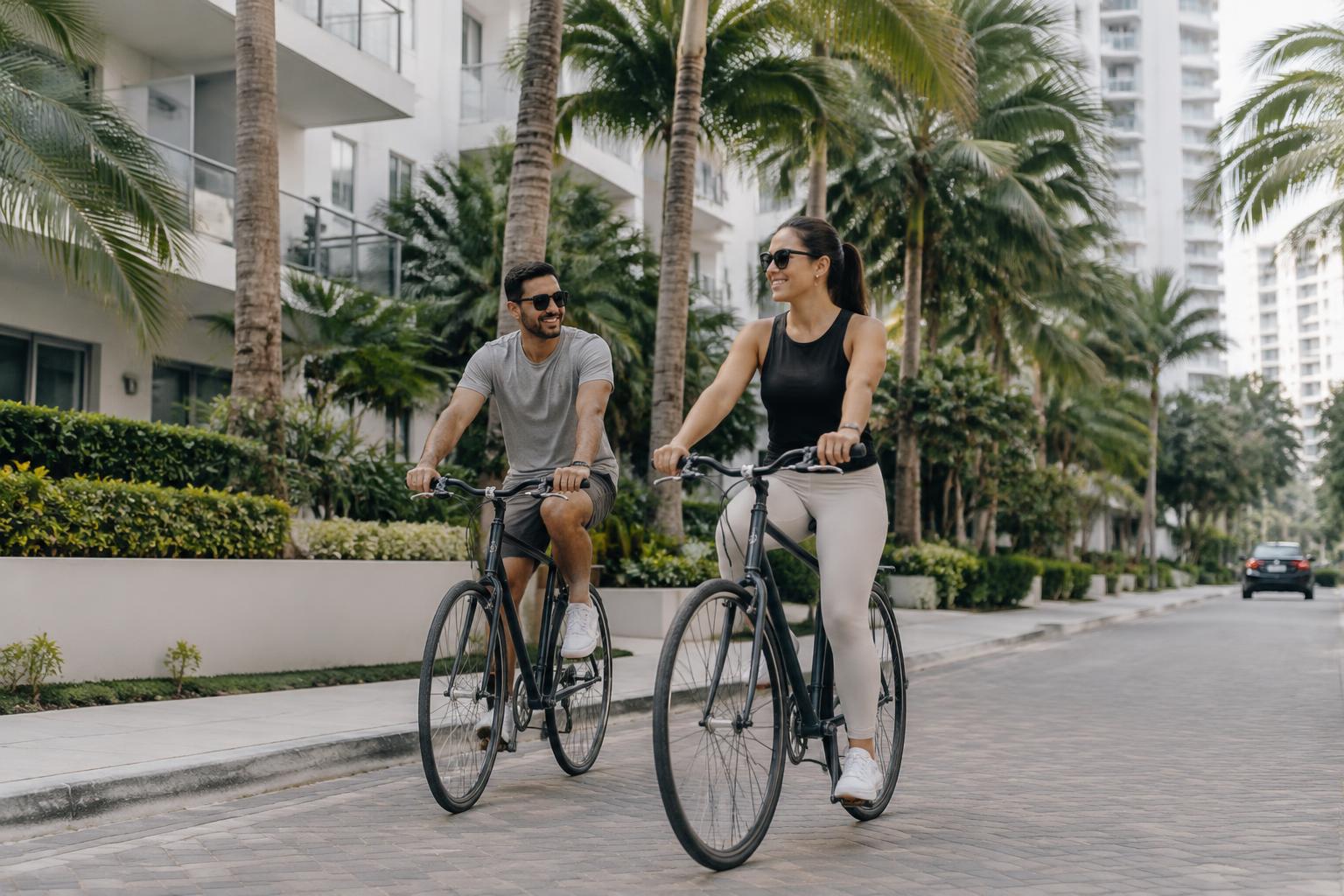
Miami route conditions and public-service checks

Image source: Miami-Dade County, Vision Zero. The image illustrates cycling and does not depict a verified Property Pedal installation.
Distinguish a proposal from a completed change
CBS Miami's March 25, 2026 report described discussion of moving bicycle travel onto the sidewalk along Northeast 5th Street. It did not establish that the change had been approved or completed. Before including that corridor in resident materials, inspect its current layout and confirm any access changes.
Check the public service separately
Before comparing a residential fleet with public bike share, confirm the public service's current coverage, equipment, participation rules, and return locations. A nearby public pickup point does not establish that a property fleet can use it.
Miami apartment fleets versus public bike share
Compare trip patterns before comparing equipment
For a Miami property, compare the verified public service with the proposed private program: where residents can collect bikes, where they must return them, who can participate, and who handles unavailable or damaged bikes. Neither model is inherently better for every trip.
Do not assume network compatibility
A designated property return area should not be treated as a public-system station. Confirm the actual return options before describing commuting or one-way travel benefits. If a public system offers e-bikes, identify those as public-system equipment. Property Pedal supplies standard non-electric bicycles.
Miami neighborhood access and resident destinations
Inspect the entire journey
For each candidate property, document the route from bike storage through the building exit and onward to a verified destination. Assess crossings, access restrictions, route continuity, and destination parking rather than relying only on proximity on a map.
Evaluate downtown connections individually
The Downtown assessments above cover different parts of the same Northeast 5th Street corridor, not separate neighborhood recommendations. Local feedback about the corridor identifies its connection to Port Miami and the fire station while raising bike-lane parking concerns. Check whether the proposed resident trip actually uses that corridor and whether the building offers a practical alternative when access is obstructed.
For transit-oriented trips, establish whether residents can complete the intended journey while following the fleet's return rules.
Miami riding conditions, safety, and equitable access
Assess conditions at the building
Before launch, assess weather exposure at the proposed storage area and along candidate routes. Establish procedures for conditions that make riding or outdoor storage unsuitable. Do not promise year-round use or describe a route as safe without a property-level assessment.
Miami-Dade County's Vision Zero page describes a countywide safety initiative. It is not certification of a particular building's access route.
Ask residents about specific barriers
Transit Alliance Miami asks residents about missing crosswalks, unshaded bus stops, and bike lanes that end unexpectedly. Use those questions to structure a building-level discussion, not as proof that each problem occurs near the property.
Ask residents about cycling confidence, physical access, app access, and useful destinations. Do not assume a standard bicycle serves every resident or that a private residential amenity addresses citywide transportation inequities.
Miami multifamily amenity planning: space, upkeep, and evaluation
Coordinate design and operations
Architects and construction managers should review the proposed bike area alongside resident circulation, access control, and maintenance access. Managers and boards should establish who receives service requests, how damaged bikes are handled, and what operating information ownership needs.
Build a property-specific decision
Compare installation and ongoing operating proposals with the amenity budget. Define how the property will evaluate resident interest and actual use without promising occupancy or rent gains.
Confirm applicable bike-parking, permitting, or transportation requirements with the relevant authority before treating a bike-share proposal as a compliance measure.
Planning a Property Pedal bike amenity for a Miami building
Property Pedal is a reseller of Koloni, whose hardware and software platform supports the program. Property Pedal provides property-branded, fully managed residential programs, including fleet sizing, installation, a resident app, and ongoing upkeep.
Its bicycles are standard non-electric models. Designated pickup and return spaces can be geofenced; suitable existing racks can often be reused, potentially reducing cost. Returns are not unrestricted, and the rider's phone location is tracked during rides.
For a Miami proposal, provide the building address, candidate bike area, and intended resident trips. Request a quote based on that site assessment rather than assumptions about citywide demand.
Sources and further reading
- 1.Vision Zero. Supporting excerpts: “Miami-Dade's Vision Zero goal is to end traffic fatalities and serious injuries by 2040”; “its 2024 Vision Zero Action Plan, which provides a five-year road map of next steps the county aims to take through the year 2028 to advance safety outcomes.” Image description: “Image of bicyclist on the road.”, Miami-Dade County
- 2.City of Miami officials are looking for solutions to safety issues for cyclists. Uploaded March 25, 2026. Supporting transcript excerpts: “Northeast 5th Street carries traffic to Port Miami and is home to a firehouse”; “from downtown on 5th at North Miami Avenue”; “cyclists using this bike lane that's protected for them often veer off into lanes of traffic when there are cars, trucks, and SUVs parked or stopped here.”, CBS Miami
- 3.Feedback on Downtown bike lanes. Supporting excerpt: “On Northeast 5th Street, which is a major corridor and key route to the Port of Miami and the Fire Station, illegal parking in the bike lane has ...”, Instagram, account not identified in the source excerpt
- 4.Neighborhood transportation feedback. Supporting excerpt: “What's not working in your neighborhood? A missing crosswalk? A bus stop with no shade? A bike lane that goes nowhere and ends randomly?”, Transit Alliance Miami
Miami neighborhoods Property Pedal serves
Downtown: Northeast 5th Street
For a Downtown building near Northeast 5th Street, inspect whether residents can reach and follow the bike lane without encountering loading or stopped vehicles; [CBS Miami documented those obstructions in March 2026](https://www.youtube.com/watch?v=891In1XUTd4).
Downtown: North Miami Avenue intersection
For a Downtown property whose departure route passes Northeast 5th Street at North Miami Avenue, assess the crossing and approach from the building before recommending the trip; [CBS Miami reported from that intersection while examining the corridor's cycling conflicts](https://www.youtube.com/watch?v=891In1XUTd4).
Downtown: Port Miami approach
For a Downtown building considering resident trips along Northeast 5th Street toward Port Miami, check how the proposed route interacts with destination traffic rather than assuming a direct connection is suitable; [CBS Miami identifies the street as carrying Port Miami traffic](https://www.youtube.com/watch?v=891In1XUTd4).
Built for Miami multifamily teams
This guide is for Miami apartment managers, multifamily owners, condo and HOA boards, architects, developers, and construction managers evaluating a residential bike amenity. It focuses on site selection, operating responsibilities, and evidence needed before approving a program.
Harbor Residences: Urban Class A Lease-Up
How an urban Class A lease-up used a branded bike share program to differentiate tours and accelerate absorption.
Frequently asked questions
How should we evaluate bike share for apartments in Miami?+
Start with the building entrance, proposed bike storage, and routes to destinations residents actually need. Check crossings, lane continuity, loading activity, and destination parking. For a downtown route using Northeast 5th Street, inspect current conditions in light of the obstructions described in the March 2026 CBS Miami report.
Can a Miami condo bike share amenity replace public bike share?+
Do not assume the two serve identical trips. Compare the public service's verified pickup and return rules with the designated spaces proposed for the property fleet. A private program should not be presented as compatible with public stations or as a universal substitute for a public network.
Does Property Pedal provide e-bikes or require special docks?+
Property Pedal supplies standard non-electric bicycles. Designated pickup and return spaces can be geofenced, and suitable existing racks can often be reused. Proprietary docks are not mandatory, but rack suitability and potential savings require a site assessment.
What should a Miami board confirm about tracking and upkeep?+
Property Pedal tracks the rider's phone location during rides, rather than claiming onboard bike GPS. Its fully managed program includes ongoing upkeep. Before approval, the board should request the applicable privacy information and clarify maintenance responsibilities, incident handling, and operating procedures.
Should a Miami property use public ridership to forecast occupancy gains?+
Do not treat public bike-share ridership as a forecast of occupancy, rent, renewals, or financial returns for a private building. Evaluate the amenity against a defined budget and resident needs, then assess actual use separately from leasing results.
Bring branded bike share to your Miami property.
Tell us about your community and we'll send a custom proposal within one business day.