Bike Share for Urban Multifamily Lease-Up: A Tour Guide
Decide when shared bikes belong in lease-up listings and tours, what the leasing team can demonstrate, and which claims need property-specific evidence.
By Kyle Sheker, Founder · February 25, 2026 · 9 min read
By Kyle Sheker
Your first tours are booked, but the shared bikes may not be installed. If your team is asking how bike share programs lift lease-up in urban multifamily, start by separating what a prospect can see from what your leasing data can prove.
A branded fleet gives the leasing team something concrete to explain. That does not establish that it accelerates absorption, replaces concessions, or changes a prospect's decision. The sources discussed here offer transportation and planning context, not evidence of those outcomes at a private apartment property.
This guide addresses a narrower decision: what should your team say, show, and publish about bike share during lease-up? Use it to coordinate photography, listing copy, tour conversations, and follow-up without getting ahead of the actual service.
What can bike share credibly add to a lease-up tour?
Bike share can give the team a concrete way to discuss how the building connects with its neighborhood. Present that connection as an available or planned service, not as proof that residents can abandon their cars or that apartments will lease faster.
The FTA and FHWA's 2015 bike-sharing FAQ describes well-planned public bike-share networks as a complement to existing transportation systems. That supports discussing transportation connections in general, but it does not establish what a private building's fleet can provide.
For a lease-up tour, choose a neighborhood example you have actually checked. An illustrative prospect might ask whether the shared bikes would suit a weekend library visit. The agent should be able to discuss the proposed outing and explain the property's return arrangement, rather than simply calling the neighborhood bike-friendly.
Route comfort matters to that conversation. NACTO's practitioner paper emphasizes places to ride where people feel comfortable and safe. Its public-system guidance is a reason to check the route, not permission to certify a particular street as safe.
For the tour notes, record:
- The destination the agent can discuss accurately.
- Any connection the team still needs to verify.
- The service limitations that belong in the explanation.
- The prospect's question, rather than an assumed transportation preference.
Keep the discussion relevant to that prospect. Do not assume every household wants a cycling commute.
When should bike share appear in lease-up marketing?
Work backward from the first photography session and tour dates, but publish only the service status you can confirm. If installation or resident access is still pending, describe bike share as planned rather than available.
Installing before photography and tours is a useful planning objective when the provider and construction schedule can support it. It is not a universal deadline or a reason to promise an installation date that has not been confirmed.
Use these three editorial states to keep the listing, brochure, and tour script consistent. This is a suggested communication framework, not an industry standard.
| Confirmed status | What the team can show | What the wording should make clear |
|---|---|---|
| Planned, not installed | An accurately labeled illustration or approved plan | The amenity is planned and not currently available |
| Installed, not open for resident use | Current photographs of the actual installation | Bikes are installed, but access has not started |
| Available for resident use | Current photographs and a verified explanation of access | Eligibility, pickup, return, and any relevant limitations |
Assign someone to update those materials whenever the status changes. Include syndicated listing copy and saved email responses, not just the property's website.
If the fleet misses the first photography date, keep the rest of the campaign moving. Add actual bike-share photography later instead of representing a rendering as an operating amenity.
For the basic service description, the bike share for apartments overview is a useful starting point. Property-specific materials still need to reflect the arrangement being delivered at your building.
How should branding connect the bikes to the tour?
Treat the branded bikes as part of the property's amenity presentation, with consistent names and accurate photographs. Do not turn branding into an unsupported claim that prospects prefer the building or that the fleet produces free advertising.
Property Pedal programs are branded to each property. For the leasing team, the practical task is making the bikes, amenity description, and tour language recognizable as the same service.
The 2018 ITDP Bikeshare Planning Guide includes system identity, communications, and community outreach and education among its planning topics. That supports treating communication as a planning responsibility; it does not establish a branding-related leasing benefit.
Prepare a small photography brief:
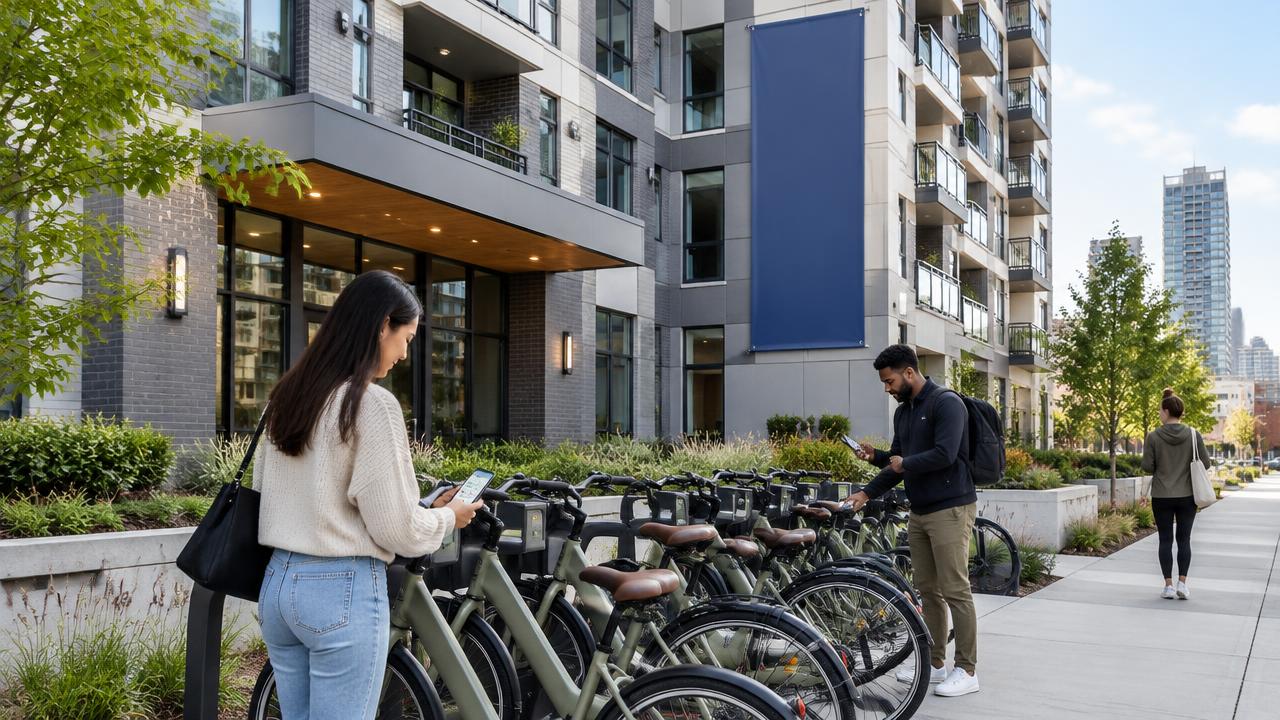
- Show the actual shared bicycles, rather than residents' privately owned bikes.
- Include enough residential context to identify where the amenity belongs.
- Show the designated pickup and return area when it is ready.
- Keep illustrations visibly distinguished from photographs.
- Avoid images that suggest electric assistance when the fleet is non-electric.
Use one approved amenity name across the listing and tour materials. If the name or graphics change before installation, update the saved descriptions as well as the main brochure.
What should the leasing team demonstrate and say?
Show the actual bikes and explain the resident experience using confirmed instructions. Keep a tour explanation separate from permission for a prospect to take a test ride.
Property Pedal supplies standard non-electric bicycles and runs programs on Koloni's hardware and software platform as a reseller of Koloni. Programs include fleet sizing, installation, property branding, the resident app, and ongoing upkeep.
The pickup and return model is not leave-anywhere riding or a proprietary-dock-only system. Designated spaces can be geofenced, and suitable existing racks can often be reused. On the tour, point to the actual designated area rather than describing a generic docking arrangement.
Suggested tour wording for an installed, active program, not a customer testimonial:
The community provides standard non-electric shared bikes. Pickup and return use the designated areas shown here. We can show you the current resident instructions and confirm access details before your move-in.
Then ask what the prospect would want to use the bikes for. A relevant question is more useful than a memorized list of benefits.
Prepare answers to the questions your own tours produce:
- How does an eligible resident get started?
- Where should the bike be collected and returned?
- What should a resident do if a bike needs attention?
- Where are the current instructions?
Do not improvise app features, availability promises, or access rules. If tracking comes up, the confirmed fact is that the rider's phone location is tracked during rides, not that the bicycles contain GPS hardware.
The how it works overview can help the team understand the service. Use the building's confirmed instructions for the actual demonstration, and avoid asking prospects to create accounts merely to follow the tour explanation.
What belongs in the weekly lease-up marketing review?
Review whether the bike-share description is accurate and whether it answers prospects' actual questions. Keep those observations separate from claims that the amenity caused a signed lease.
Use an ordinary leasing log rather than assuming a particular software report exists. A suggested weekly review can capture:
| Record | How it helps the next tour cycle |
|---|---|
| Current amenity status | Shows whether listing and tour language need updating |
| Tours where the amenity was discussed | Provides context for interpreting the comments collected |
| Questions raised without prompting | Identifies information prospects are actively seeking |
| Questions the agent could not answer | Creates a specific correction or follow-up task |
| Mismatches between advertised and actual service | Identifies copy that should be corrected promptly |
| Prospect comments about the leasing decision | Preserves feedback without assigning causation |
Define each record before comparing weeks. A count of prospect mentions means little if one agent asks everyone about bikes and another records only unsolicited comments.
For example, if prospects repeatedly ask whether the bikes provide electric assistance, clarify the non-electric fleet description in the listing and tour script. That is an actionable communication finding, not evidence that changing the wording will increase conversions.
Resident registrations and rides answer different questions from prospect feedback. They may help assess service use after move-in, but they do not show why a household signed its lease. Do not set an adoption benchmark from the unsupported percentages in an earlier draft or treat registrations as completed rides.
If leasing performance changes, retain the context: asking rents, concessions, available homes, marketing changes, and other amenity openings. A before-and-after improvement alone is not enough to attribute the result to bike share.
Frequently asked questions
Can we list bike share before the bikes arrive?
Use clearly qualified wording such as planned bike share when the project is confirmed but not operating. Avoid presenting it as available now or attaching an opening date that has not been confirmed.
Make the same distinction in the website, listings, brochures, and saved leasing responses. A qualification in one channel does not correct conflicting wording elsewhere.
Should prospective residents be offered test rides?
Do not assume that resident access rules also permit prospect test rides. Confirm eligibility, applicable terms, and the approved demonstration process before offering one.
If prospect riding has not been approved, use a stationary explanation of the bikes and current instructions. The tour can still communicate the amenity without creating an unconfirmed access arrangement.
Can we use public bike-share photos in our listing?
Use photographs that accurately represent your property's service and that you have permission to publish. A public-system photograph should not stand in for the private fleet residents will receive.
For a planned amenity, label an illustration clearly. In particular, do not use a public e-bike image to represent Property Pedal's standard non-electric bicycles.
Does a prospect mentioning bike share prove it helped close the lease?
A prospect's comment is useful feedback, but it is not proof of a causal leasing effect. Record whether the comment was volunteered or prompted and what the prospect actually said.
Keep the feedback in the leasing review without converting it into an absorption forecast. A signed lease can reflect several considerations that the comment does not capture.
What should an agent say when bike share is unavailable during a tour?
State the current service status and explain only the next steps that have been confirmed. Do not promise a restoration date or a bike for a particular outing unless that commitment has been verified.
If the interruption changes what prospects can reasonably expect, check whether current listing and follow-up language also need revision. An unavailable amenity should not be presented as ready for immediate use.
What should the regional manager approve before the next tour cycle?
Approve the description, images, and demonstration that match the program's confirmed status. Hold claims about faster leasing, lower concessions, or resident transportation savings unless appropriate evidence supports them.
The approval package can be brief: current status, approved copy, selected images, tour wording, unresolved questions, and the person responsible for updates. This is a marketing approval, not a substitute for operational launch checks or contract review.
To assess whether and how bike share programs lift lease-up in urban multifamily, start with an accurate tour story and collect property-specific evidence without promising the result. The immediate goal is a service the team can explain honestly, on the dates it can actually deliver.
For a program scoped around your property's photography and tour calendar, request a quote.
Sources and further reading
- 1.Frequently Asked Questions and Answers Concerning Bike Sharing Relative to the United States Department of Transportation, Federal Transit Administration and Federal Highway Administration
- 2.Equitable Bike Share Means Building Better Places for People to Ride, National Association of City Transportation Officials
- 3.The Bikeshare Planning Guide, 2018 Edition, Institute for Transportation and Development Policy