Bike Share ROI for a 150-Unit Condo: The Amenity That Pays for Itself Many Times Over
The full ROI math on bike share for a 150-unit condo, fleet sizing, retention, rent premium, NOI, and a side-by-side cost comparison vs. gyms, dog washes, and game rooms.
By Kyle Sheker, Founder · March 11, 2026 · 8 min read
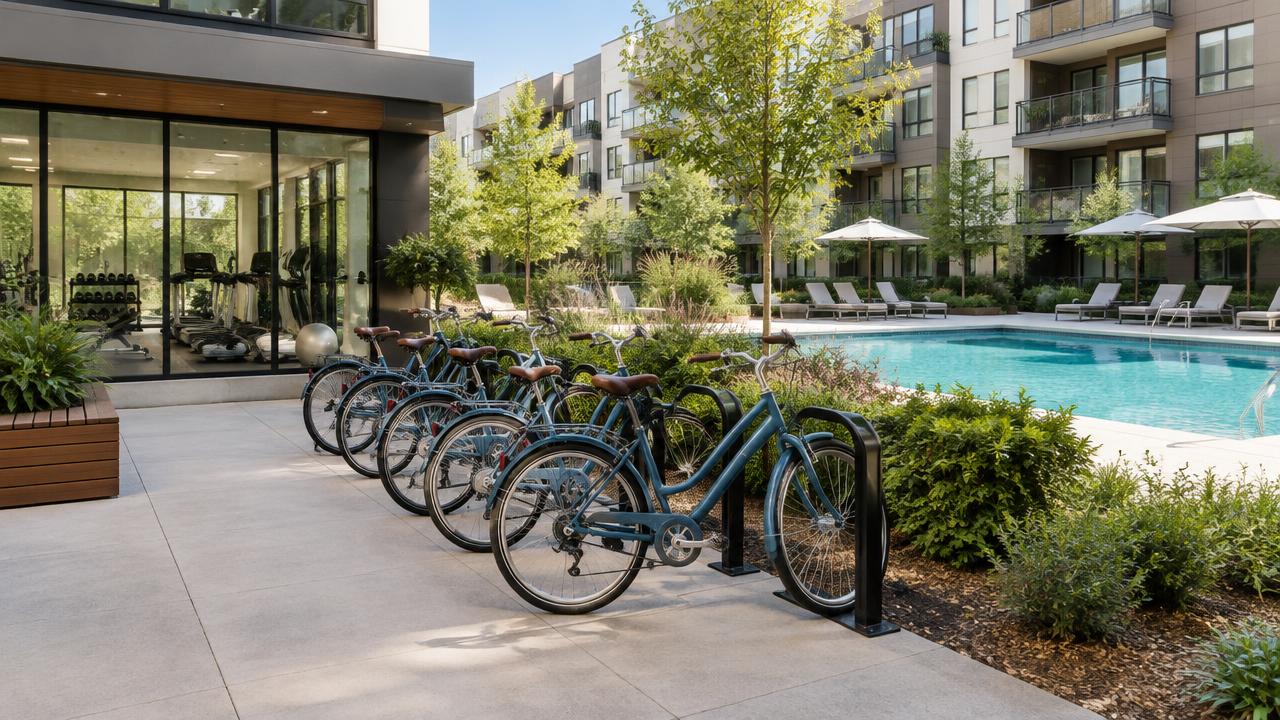
Every condo board and asset manager we talk to is running the same playbook: amenity arms race, rising capex, residents who expect more for the same dues. Most amenities in that race cost five and six figures and produce soft, hard-to-measure returns. Bike share is the outlier. Even after fully loading the program cost, hardware, software, maintenance, support, and lifecycle replacement, the ROI on a typical mid-size condo is lopsided enough that not running the numbers is the only way the decision looks hard.
Below is the same model we walk condo boards and property managers through. The property in this example is a 150-unit condo; the numbers scale linearly if yours is bigger or smaller.
Fleet sizing and the real program cost
Bike share is priced per bike, all-in, at roughly $1,800 per bike per year. That number includes hardware, software, scheduled maintenance, repairs, resident support, and lifecycle replacement, not a teaser rate that balloons once service starts.
For a 150-unit condo, a healthy fleet is typically 6 bikes (roughly one bike per 25 units). That puts the all-in program cost at:
- 6 bikes × $1,800 per bike per year = $10,800 per year
- $10,800 ÷ 150 units = $72 per unit, per year, about $6 per unit per month
Smaller fleets (4 bikes, $7,200/year) work for lower-density buildings; larger urban Class A properties often sit at 8 bikes ($14,400/year). The per-bike line item includes:
- Hardware, branded bike and dock hardware
- Software, resident app, unlock, ride tracking, and admin dashboard
- Maintenance, scheduled service, repairs, and parts
- Customer support, direct resident support so your on-site team doesn't field tickets
- Lifecycle replacement, bike and components refreshed on a planned cadence
There is no separate install fee that doubles the year-one cost, no per-ride markup that balloons with usage, and no maintenance contract sold as an upsell. The per-bike number is the line item.
Retention math: the line item that makes the rest irrelevant
Turning over a single condo unit, whether it is a rental flip or an owner sale that triggers concessions, marketing, and make-ready, costs the asset $3,000 to $5,000 once you count lost rent, leasing time, marketing, paint, cleaning, and minor repairs. Industry benchmarks consistently land in that range and the high end is conservative for Class A properties.
If bike share contributes to three extra renewals per year across 150 units, the program covers its full $10,800 annual cost on retention alone (3 × $3,000 to $5,000 = $9,000 to $15,000). Three renewals. Out of 150 units. That is the breakeven case, not the success case.
The success case is what we actually see in resident exit surveys: bike share gets cited unprompted alongside the gym and package room as a reason residents stayed. On a 150-unit property, five to eight extra renewals per year is a realistic, defensible outcome, which is $15,000 to $40,000 of avoided turn cost against $10,800 of program spend, before you touch rent or valuation.
Rent premium: where the real money is
Condos and rental multifamily with branded mobility amenities defend $10 to $25 per month in additional rent or HOA-justified amenity fees on comparable units. Take the midpoint, $17.50 per unit, per month, across 150 units:
- $17.50 × 150 units × 12 months = $31,500 per year in incremental revenue
- Cost of the amenity producing that revenue: $10,800
- Net contribution to NOI: $20,700 per year
The conservative end of the range ($10/unit/month) produces $18,000/year in additional revenue against $10,800 in cost, a net $7,200 NOI lift and a 1.7x revenue-to-cost ratio. The aggressive end ($25/unit/month) produces $45,000/year, a net $34,200 NOI lift and roughly 4x revenue-to-cost.
NOI to valuation: the number that makes ownership pay attention
Multifamily and condo-rental assets trade on cap rates. Every dollar of additional NOI is worth roughly $18 of asset value at a 5.5% cap rate. Using the midpoint rent premium above:
- $20,700 in incremental annual NOI ÷ 5.5% cap rate = ~$376,000 in additional asset value
- Conservative end ($7,200 NOI lift) → ~$131,000 in additional asset value
- Aggressive end ($34,200 NOI lift) → ~$622,000 in additional asset value
- The amenity producing it: $10,800 per year
A $10,800 line item that adds a six-figure, and at the midpoint, mid-six-figure, bump to asset value is not an amenity decision. It is a capital allocation decision that almost any other line item in the operating budget would lose to.
Side-by-side: bike share vs. other amenities residents ask for
Boards and asset managers often weigh bike share against the usual amenity wish list, a dog wash, a game room, a fitness room refresh, a golf simulator. Here is the honest cost comparison on a 150-unit property:
- Bike share, $10,800/year all-in for a 6-bike fleet, $72 per unit per year
- Dog wash station, $8,000 to $15,000 install plus ongoing supplies and maintenance, $60 to $110 per unit amortized
- Game / rec room, $40,000 to $80,000 buildout plus annual opex, $300 to $550 per unit
- Fitness room refresh, $75,000 to $150,000 for current equipment and finish work, $550 to $1,100 per unit
- Golf simulator, $50,000+ install, $350+ per unit, plus ongoing licensing and maintenance
Every one of those amenities can be the right call for the right property. None of them produce a comparable rent-premium return, and most of them require a capital reserve draw that bike share, funded out of operating budget at roughly $6 per unit per month, simply does not.
Common objections, and the honest responses
"We already have bike racks." Bike racks are storage. Bike share is an amenity residents actually use without owning, maintaining, or worrying about theft. Residents who would never buy a $1,200 bike will take a five-minute ride on a Saturday morning.
"Our residents won't use it." Healthy programs on properties of this size see 40% to 60% of new move-ins register within their first month. Usage is not the constraint, installation visibility and branding are.
"What about liability?" Programs run by operators rather than self-managed by the property carry their own insurance. Your association or asset is not the insurer of the amenity.
"It's a fad." Mobility is the fastest-growing amenity category in multifamily and is now a default line item on new Class A acquisitions. It is moving in the opposite direction of a fad.
When it doesn't pencil
We will say it plainly: bike share does not always make sense. Properties in extremely low-density suburban markets with no rideable destinations, properties with fewer than 40 to 50 units where the per-unit math gets tighter, and properties already saturated with high-utilization mobility (a transit station literally on the property) are cases where the return narrows. For everything else, and 150-unit urban and suburban Class A condos sit squarely in the sweet spot, the math is not close.
The bottom line
Spending $10,800 a year to defend $20,000-plus in NOI and roughly a third of a million dollars in asset value is the kind of decision that does not deserve a six-month committee review. If you want a proposal modeled against your specific property and fleet size, we can put one together in about a business day.