Bike Share for Condos: Reviewing the Rider Agreement
A clause-to-instruction review for condo boards comparing proposed rider terms with the actual bike-share service, without assuming legal protection or app features.
By Kyle Sheker, Founder · October 16, 2026 · 9 min read
By Kyle Sheker
Your board has a proposal for bike share for condos, but the rider agreement describes features nobody has confirmed. Perhaps it mentions electric bicycles, a waiver accepted through an app, or a return process that differs from the resident instructions. Before releasing those documents, the board needs a narrower decision than whether shared bikes are a good amenity: do the proposed terms accurately describe the service residents would receive?
This guide provides an editorial and operational review, not legal advice or a ready-to-sign waiver. Use it to identify inconsistencies for the provider and association counsel, without treating another operator's agreement as proof of your program's capabilities or legal protection.

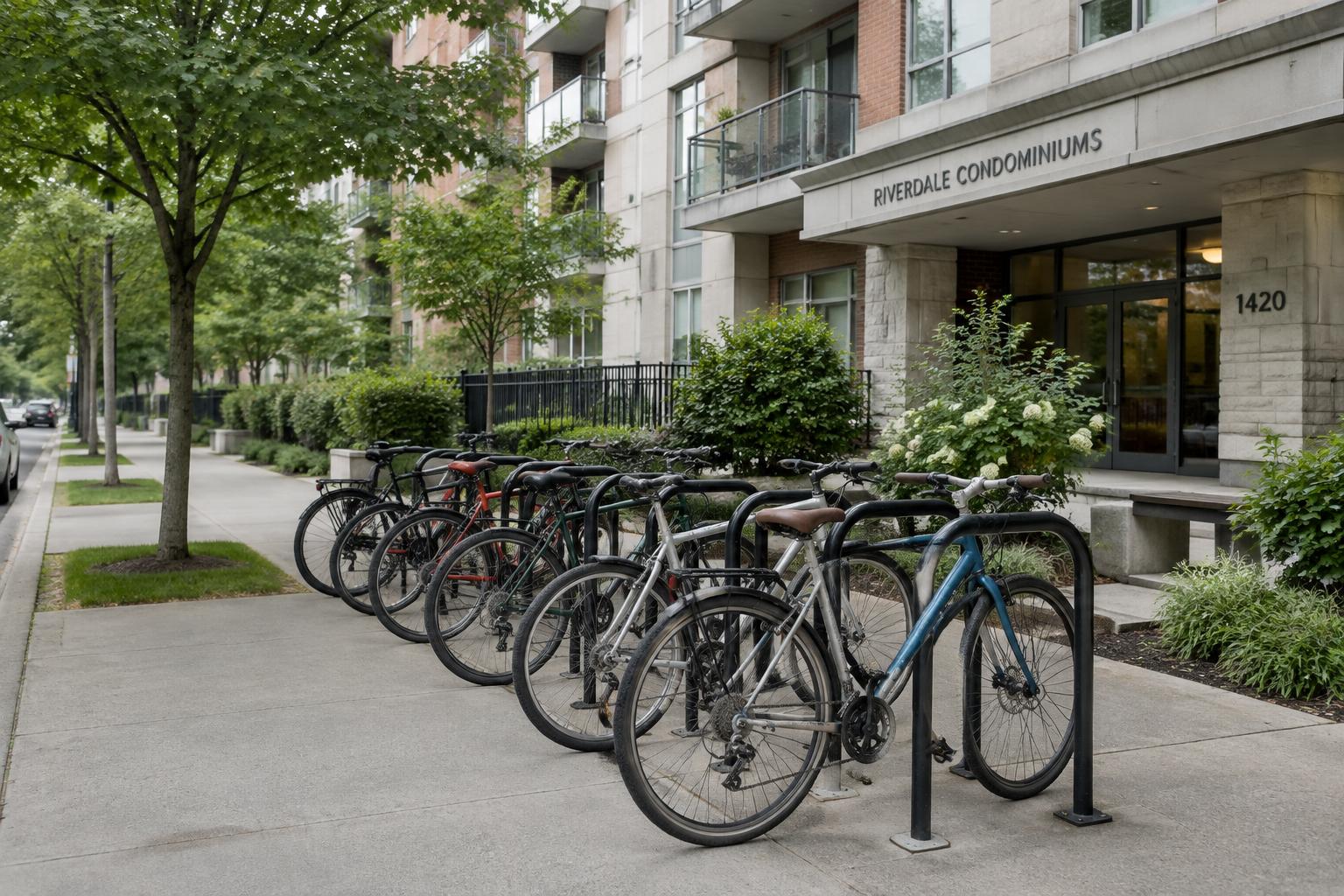
Illustration of standard bikes at existing racks; actual fleet design and site placement depend on the property.
What should the board review for bike share for condos?
Review whether the proposed rider agreement, resident instructions, and quoted service describe the same program. Recommend resident-facing release only after material operational questions are answered and counsel has reviewed the legal wording.
Keep this review separate from the broader decision about funding or launching the amenity. The task here is not to choose fleet size, allocate common space, or predict resale value. It is to prevent the association from publishing instructions that conflict with the proposed service.
Start with these documents:
- The proposed rider agreement, with its version or date.
- The service description supplied for your property.
- Draft resident instructions, including any screenshots the provider supplies.
- The provider's written answers about features referenced in those instructions.
If one document is missing, identify the gap rather than filling it with language copied from another program. A public agreement can help you formulate a question, but it cannot answer what your provider offers.
For broader program context, see bike share for condos. This review begins with the documents residents would actually read.
What can published rider agreements tell a condo board?
Published agreements show how named operators describe rider responsibilities and acceptance steps. They are comparison material, not evidence that the same terms, protections, or software features apply to your property.
The following examples come from different programs. Their differences are useful because they expose details that a generic waiver reference can hide.
| Supplied example | What the document actually says | Question to raise about your draft |
|---|---|---|
| California State Employee BikeShare form | Participants must complete orientation and sign and submit the form before participating. | What acceptance and orientation steps does our proposed program actually use? |
| Capital Bikeshare release | Riders agree to inspect the bicycle before riding and not ride a damaged or defective bicycle. | Do our resident instructions explain what to do when a pre-ride check reveals a problem? |
| On Bike Share FAQ | This separate vendor says its system integrates a waiver into registration and permits customization in its administration system. | Has our provider confirmed its own process, rather than someone else's? |
| ValleyBike terms | The terms describe amendments and continued use after updates. | How will proposed changes to our documents be reviewed and communicated? |
These examples do not establish whether any provision is enforceable for your association. They also do not verify Property Pedal or Koloni app workflows.
Use the examples to annotate your draft with specific questions. Replace a vague note such as “confirm waiver” with a request for the actual proposed acceptance process and the document residents would receive.
How should rider terms describe bike share for condos?
Match each equipment and return description to the proposed service before reviewing the wording for residents. For Property Pedal, that means standard non-electric bicycles and designated pickup and return spaces that can be geofenced, as described in the condo planning guide.
That operating model is neither unrestricted leave-anywhere riding nor a requirement to install proprietary docks. Existing racks can often be reused when their condition and location are suitable, but the property's actual arrangement still needs confirmation.
Check the draft for mismatches such as:
- Battery or electric-assist instructions attached to a standard-bike program.
- Permission to leave a bicycle at any convenient rack.
- References to a proprietary dock when the proposal describes designated return spaces.
- Instructions naming a rack that has not been confirmed for the shared fleet.
The rider's phone location is tracked during rides. Do not describe that as bike-mounted GPS or as a guarantee that a bicycle has physically returned.
Suggested drafting note, not contract language: Identify the approved return spaces in the resident instructions, then ask the provider to explain the proposed return process and how exceptions are handled.
Keep the equipment description consistent across the agreement, welcome message, and signage. If the proposed return arrangement changes, revisit all three rather than updating only the site map.
How can the board check each clause against resident instructions?
Use a clause-to-instruction crosswalk that pairs each draft rule with the action a resident is told to take. Flag any instruction that requires an unconfirmed app feature or leaves the next step unclear.
The crosswalk below is a suggested review tool, not a description of included Property Pedal capabilities. Complete it using the proposed documents and provider responses.
| Agreement topic | Resident's practical question | What to confirm before release |
|---|---|---|
| Acceptance of terms | What must I read or complete before participating? | The actual acceptance step and the document presented, without assuming registration or per-ride acceptance. |
| Pre-ride inspection | What should I do if the bicycle appears damaged? | The proposed instructions for not riding and contacting the responsible party. |
| Return location | Where exactly should I leave the shared bicycle? | Matching location descriptions in the agreement, instructions, and property map. |
| Return difficulty | What if I cannot complete the proposed return process? | A confirmed support route and instructions, not an assumed automatic alert. |
| Changes to terms | Which document applies after an update? | The review and communication process proposed for revised documents. |
For each row, record the relevant clause, instruction, and unresolved question. Keep the provider's answer beside the question so a later editor can see why the wording changed.
For example, a draft might require residents to report a damaged bicycle but offer no contact method. The repair is to confirm that method and add it consistently, not to invent an in-app reporting button.
Similarly, a screenshot of a registration page is not enough to establish when terms are accepted. Ask the provider to explain the proposed sequence and identify which parts have actually been demonstrated.
The Capital Bikeshare release offers a concrete example of a pre-ride inspection obligation. It does not establish the fault-reporting method for your property, so keep those two questions separate.
Which scenarios reveal gaps before publication?
Read the draft against ordinary bike-share situations rather than reviewing it only clause by clause. Record where a resident would need information that neither the agreement nor the instructions provide.
The following are hypothetical document tests, not customer incidents or demonstrations of current software behavior.
Scenario 1: A resident notices a problem before riding.
A resident reaches the shared fleet and notices something that appears wrong with a bicycle. Can the resident find clear instructions not to ride it and a confirmed way to report the concern? Does the agreement refer to the same contact route as the welcome message?
Do not assume that a repair report goes through the app, triggers dispatch, or receives a particular response time. Those details need confirmation in the proposed service arrangements.
Scenario 2: A resident returns to the wrong rack.
The property has racks for personal bicycles as well as a designated shared-bike return space. Would someone reading the instructions know which location to use? If the resident is already at the wrong rack, is the next step explained?
This is a wording test, not a guarantee that geofencing prevents incorrect returns. Check whether the instructions distinguish the shared-bike location without implying that every existing rack qualifies.
Scenario 3: The welcome message and agreement disagree.
A revised return instruction appears in the agreement, but the welcome message still contains the previous wording. Identify every place where the obsolete instruction appears, including any printed sign or saved attachment.
Then record who will update those materials before release. A review is incomplete if the central document is accurate but the version residents are likely to open still says something different.
What should owners be told about the agreement?
Tell owners what the proposed service includes and which resident instructions are still being reviewed. Keep claims about insurance protection, resale value, or guaranteed returns out of that explanation.
Do not present a waiver or ride record as evidence that insurance requirements have been satisfied. Direct coverage questions to the association's insurance advisor and legal questions to counsel, using the actual proposed documents rather than a general description of the service.
Likewise, a managed maintenance arrangement should not be described as guaranteeing unchanged or reduced association liabilities. The communication can explain the proposed division of work without promising a legal outcome.
Illustrative owner update, to adapt after review:
The board is reviewing the proposed shared-bike rider agreement alongside the resident instructions. The review checks that equipment descriptions, return locations, and contact information match the proposed service. Questions about legal wording and insurance are being referred to the association's advisors. Resident instructions will be released after material inconsistencies are resolved.
There is no need to support this update with a claimed resale premium. The published agreements discussed here describe their own programs; they do not establish financial outcomes for a private condo fleet.
Frequently asked questions
Can we copy a public bike-share waiver?
Use published waivers to identify questions, not as a ready-to-sign document for your association. Give counsel the proposed service description and rider terms so the review addresses your program rather than another operator's equipment and processes.
Should our rider instructions include electric-bike clauses?
Property Pedal supplies standard non-electric bicycles, so its rider instructions should not describe an electric fleet. Capital Bikeshare's electric-bike provisions belong to that separate public system and should not be imported as descriptions of Property Pedal's offering.
Does phone tracking confirm a bicycle's physical return?
The rider's phone location is tracked during rides, but that should not be represented as proof that the bicycle has physically returned. Ask the provider to explain the proposed return process and exception handling without assuming bike-mounted GPS, a particular location precision, or guaranteed recovery.
What if resident instructions refer to an unconfirmed app feature?
Remove the feature claim until the provider confirms the proposed workflow. A separate vendor's published registration or waiver capability does not verify that capability for Property Pedal or Koloni.
When is the rider agreement ready for resident release?
Recommend release when the reviewed agreement and resident instructions match the proposed service and material operational questions have been resolved. If an instruction still depends on an assumed feature, return that portion for clarification instead of publishing it.
Use this final editorial check:
- Equipment descriptions match the proposed standard-bike fleet.
- Return instructions name the same designated spaces throughout.
- Acceptance and support steps reflect confirmed processes.
- Counsel has reviewed the legal wording, with coverage questions directed to the insurance advisor.
- The version intended for residents matches the reviewed version.
For bike share for condos, a clear agreement is one that describes the proposed service accurately, not one that promises the broadest protection. Keep the publication decision focused on that test rather than treating it as a substitute for the association's broader approval process.
To obtain a property-specific service scope for this review, request a quote.
Sources and further reading
- 1.State Employee BikeShare Program Assumption of Risk, Liability Waiver and Release Agreement, California Department of General Services
- 2.Capital Bikeshare Liability Waiver, Capital Bikeshare
- 3.Frequently Asked Questions about the On Bike Share System, On Bike Share
- 4.ValleyBike Terms of Use, ValleyBike
- 5.Bike Share for Condos: A Board and Manager Planning Guide, Property Pedal