Turnkey Bike Share for Property Managers: A Decision Guide
Use a service-responsibility review to identify who handles shared-bike tasks, where issues escalate and what remains unresolved before regional approval.
By Kyle Sheker, Founder · October 16, 2026 · 9 min read
By Kyle Sheker
Before recommending turnkey bike share for property managers, ask a practical question: does the written proposal assign the work your team expects the provider to handle? A managed service should be evaluated through documented responsibilities, not assumptions about what happens when a resident cannot start a ride or a bicycle needs attention.
For a Class A community preparing for lease-up or refreshing its amenities, the decision is whether the proposed service fits the team's capacity. This guide provides a service-responsibility review for that decision, rather than another rack-placement checklist or maintenance schedule.
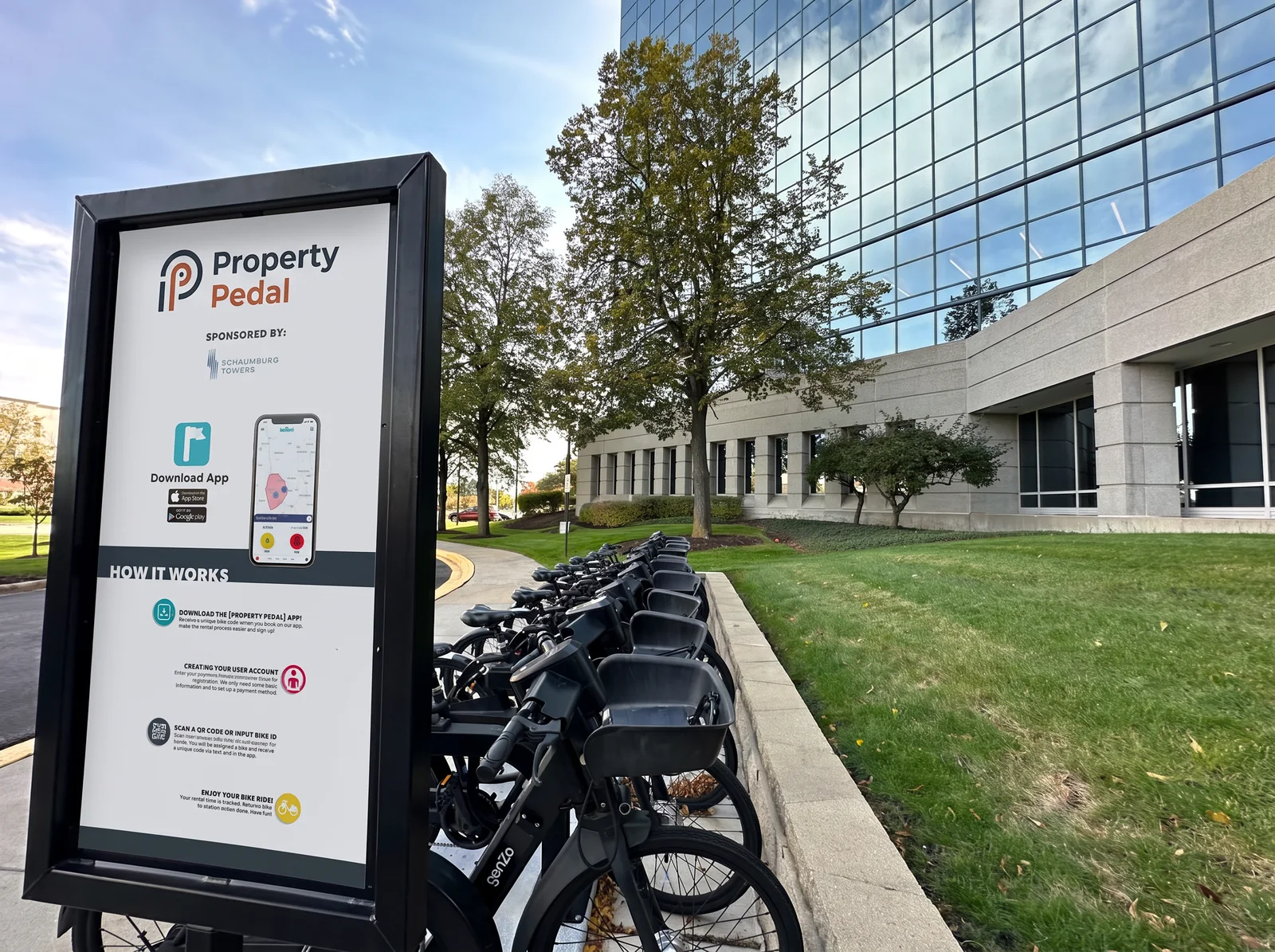
Property Pedal bike share installation outside a professionally managed property.
What does turnkey bike share for property managers include?
Property Pedal's turnkey program includes fleet sizing, installation, property branding, a resident app and ongoing upkeep. It supplies standard non-electric bicycles and operates as a reseller of Koloni, whose hardware and software platform powers the program.
Start with those confirmed capabilities when reviewing the proposed scope. The bike share for property managers overview provides context for the managed offering, including installation, branding and maintenance.
For the proposal review, separate the included service categories from their property-specific details:
- Fleet sizing and installation: Identify the equipment and installation work being proposed.
- Property branding and resident app: Record the materials and setup described in the scope.
- Ongoing upkeep: Locate the written description of the maintenance service.
Do not expand those categories into unconfirmed promises about response times, automated reporting or replacement coverage. Keep any additional requested capability on an open-questions list until it is confirmed in writing.
How does the turnkey model handle maintenance and repairs?
Property Pedal hires local mechanics for ongoing bicycle upkeep. Confirm the proposed maintenance scope before treating any inspection frequency, repair deadline or replacement provision as included.
The useful distinction is between the service category and the commitment. Ongoing upkeep describes an approved part of the offering; it does not establish a particular inspection checklist, uninterrupted availability or an unconditional safety guarantee.
Ask the provider to identify the proposed maintenance responsibilities and exclusions. Keep that answer with the service proposal rather than writing your own assumed schedule into the regional recommendation.
Maintenance should not be presented as eliminating the property's liability. Refer legal and coverage questions to counsel and the property's insurance advisor, using the actual proposed agreement.
The how it works overview provides additional program context. Use the property-specific scope to establish what has actually been offered.
How should you review turnkey bike share for property managers?
Review the proposal task by task, recording who does the work, who receives an escalation and which commitments remain unresolved. Recommend approval only when the responsibilities your team needs are documented rather than implied by the word turnkey.
Use a service-responsibility register, not a launch timeline. Its purpose is to expose work that has no agreed owner, even when the equipment and layout appear ready.
There is a useful precedent for requesting operational detail. The Bay Area Air Quality Management District's bike-share procurement appendix asks respondents to document an inspection schedule and maintenance standards in item 1.01, and maintenance schedules and an audit procedure in item 3.01. These are public-system procurement questions, not residential service requirements or evidence of Property Pedal's specific commitments.
Use that distinction when completing the register below. Every entry is a question to resolve from the proposed agreement, not a statement that the service is included.
| Task to review | Written scope to request | Task owner and escalation contact | Unresolved commitment |
|---|---|---|---|
| A shared bicycle needs repair | Proposed repair responsibilities and handling of an affected bicycle | Owner: ___; escalation: ___ | Timing, exclusions and confirmation of completion: ___ |
| A resident cannot access a bike | Proposed access-help process and any property involvement | Owner: ___; escalation: ___ | Contact method, availability and backup route: ___ |
| A bicycle is outside the designated return space | Proposed reporting and return-exception process | Owner: ___; escalation: ___ | Who responds and what staff are expected to do: ___ |
| A bicycle is missing | Proposed missing-equipment procedure | Owner: ___; escalation: ___ | Reporting responsibilities and any replacement arrangements: ___ |
| Resident instructions need updating | Proposed responsibility for preparing and changing instructions | Owner: ___; escalation: ___ | Who approves and distributes the revised version: ___ |
| The property requests a service change | Proposed process for changing the agreed scope | Owner: ___; escalation: ___ | Written confirmation needed before the change takes effect: ___ |
Add the proposal section or dated provider response beside each completed row. A task owner should identify the party responsible for the work, while the escalation contact should identify where an unresolved issue goes.
Mark each commitment using one of these review statuses:
- Documented: The written scope identifies the responsibility and relevant limitations.
- Excluded: The provider has identified work outside the proposed service; the property must decide whether that exclusion is acceptable.
- Unanswered: The proposal or response does not yet resolve the question.
These are suggested review labels, not platform features. Do not mark a row documented simply because a sales conversation used the phrase fully managed.
An exclusion is not automatically a reason to reject a proposal. It is a reason to decide explicitly whether the remaining work fits your team's capacity, rather than letting it become an informal duty after approval.
What should an escalation contact actually own?
An escalation contact should be responsible for moving an unresolved issue to the next agreed step. Record that responsibility separately from the initial contact method and any promised response time.
Ask the provider to explain the proposed route for a resident issue and for a manager's unresolved service concern. Do not assume those routes are identical or that either involves an automated app notification.
Item 3.02 of the same public procurement appendix asks respondents to describe the notification or metrics system used to determine when bicycles need repair or replacement. It supports asking for the process, not assuming a particular process exists in your proposed program.
For each service route, request:
- The initial contact method residents or managers should use.
- The party responsible for the next action.
- Any proposed contact availability and response commitment.
- The escalation route when the first contact does not resolve the issue.
- What, if anything, the property must communicate or do.
- How completion would be communicated under the proposed service.
Hypothetical proposal test, not a customer incident: A resident can open the app but cannot start a ride. The proposal mentions software and maintenance, but does not identify who determines the next step.
Ask the provider to assign responsibility for that situation without requiring the leasing team to diagnose the cause. Record the answer, including any staff involvement, rather than assuming the software provider and mechanic will coordinate automatically.
Property Pedal's reseller relationship with Koloni does not by itself define the property's escalation route. Confirm the proposed service contact instead of treating the technology partner's name as a support instruction.
What should the scope say about racks and geofencing?
Existing bike racks can often be reused where suitable, which may save the customer money. Designated pickup and return spaces can be geofenced to suit the property.
Property Pedal's hybrid model is neither unrestricted leave-anywhere riding nor a requirement to install proprietary docks. The rider's phone location is tracked during rides, but that should not be presented as proof of a bicycle's physical return or a guarantee that a session cannot end outside an approved zone.
For this service review, the important question is who owns exceptions and changes. Ask who handles a reported bike outside the designated space, who approves a proposed location change and which changes require a revised scope.
How should you assess the site for geofencing?
Ask the provider to identify the proposed pickup and return spaces and confirm whether existing racks are suitable. Record who approves any changes and request a property-specific installation schedule.
Keep the confirmed locations with the service proposal so the responsibilities refer to an identifiable arrangement. Do not attach an assumed installation deadline or construction saving to the use of geofencing.
Broader resident access and site-planning considerations belong in the bike share for apartments overview. Here, the review remains focused on what the provider and property have agreed to do.
Frequently asked questions
Does the building staff have to manage check-outs?
Property Pedal's offering includes a resident app, but the property-specific checkout process should be confirmed. Ask the provider to document any staff involvement and the contact for access problems.
Keep those answers in the responsibility register. Do not turn the presence of an app into an assumed access speed or a claim about other checkout methods.
How are bikes left outside the return zone handled?
Property Pedal can geofence designated pickup and return spaces and tracks the rider's phone location during rides. Ask for the proposed out-of-zone return process rather than assuming geofencing prevents abandonment or guarantees a bicycle's return.
Record who receives a report, who takes the next action and whether any property involvement is proposed. Treat unanswered steps as unresolved commitments.
What happens if a bike is stolen?
Confirm the missing-bike procedure and responsibility for any replacement in the proposed agreement. Do not assume asset tracking, recovery assistance or replacement hardware is included.
Keep the service question separate from insurance questions. Ask the property's insurance advisor to review coverage rather than inferring it from the provider's maintenance role.
Can we charge residents to use the bikes?
Confirm available resident payment arrangements with the provider before deciding to charge for rides. Do not assume a free, subsidized or pay-per-use configuration is supported by the proposed program.
Request written confirmation of the arrangement being proposed and who would handle related resident questions. Leave projected resident revenue out of the recommendation until the necessary capabilities and terms are confirmed.
When is the service scope ready for regional approval?
Recommend approval when the proposed scope assigns the necessary tasks, identifies escalation contacts and makes exclusions clear. Return unresolved commitments for clarification when they could leave work with a team that has not agreed to perform it.
Attach the completed responsibility register to a short regional recommendation. Include:
- The proposal version and written responses used in the review.
- The work assigned to the provider.
- Any responsibilities the property has agreed to retain.
- The agreed escalation contacts and any documented service commitments.
- Exclusions the regional manager needs to accept or resolve.
- Unanswered questions that prevent a recommendation.
Keep the decision narrow. This review establishes whether the proposed division of work fits the property; it does not demonstrate a rent premium, a renewal improvement or superiority over another amenity investment.
A sound decision about turnkey bike share for property managers rests on documented responsibilities, not an assumed financial return. To discuss a property-specific program and service scope, request a quote.