Apartment Parking Pressure and Bike Share Strategy
A parking-demand framework for apartment managers: document stall shortages, separate vehicle storage from bike trips, and decide whether a parking-focused trial is justified.
By Kyle Sheker, Founder · October 26, 2026 · 9 min read
By Kyle Sheker
If residents cannot find a space at night, evaluating apartment parking pressure and bike share starts with counting parked vehicles, not short drives. Replacing a car trip does not necessarily reduce the number of vehicles stored on-site, so the parking case needs separate evidence.
For property managers and regional teams considering a mobility amenity, the decision is whether bike share deserves investigation as a parking intervention or should be evaluated only as a resident service. This guide provides a suggested parking-demand assessment, not a prediction that installing shared bikes will free vehicle stalls.
Can bike share ease parking pressure at an apartment community?
Bike share may be worth testing as part of a parking strategy, but fewer car trips do not establish lower residential stall demand. A resident who rides instead of driving can leave the same car parked at home, so a parking-relief claim needs evidence that fewer vehicles need space during the property's shortage periods.
Keep three questions separate:
- Are residents taking shared-bike trips?
- Are those trips replacing drives rather than walking, transit, or outings that would not otherwise happen?
- Has the number of vehicles needing residential parking changed?
Only the last question directly addresses the building's vehicle-storage problem. The first two may support a transportation discussion, but they cannot substitute for parking observations.
Illustrative example, not property data: A household makes two shared-bike outings but keeps its car in its assigned stall. Bike use increases, yet the household still occupies the same residential parking space.
Avoid presenting an active fleet as proof of parking relief. A useful amenity and a demonstrated reduction in stall demand are different findings, and either should be described on its own terms.
How do you evaluate apartment parking pressure and bike share?
Start by recording where and when residents cannot find parking, then measure parked vehicles separately from bike trips. Before recommending bike share for parking relief, identify a plausible change in vehicle-storage demand and the evidence needed to test it.
ITDP's Bikeshare Planning Guide lists establishing performance metrics and examining feasibility among its planning topics. That planning context does not establish a parking benefit for a private apartment fleet; the worksheet below is an original suggested assessment for the property.
| Assessment record | What to capture | Why it matters to the parking decision |
|---|---|---|
| Shortage location | Garage level, surface lot, building entrance, or assigned parking area | Distinguishes a localized problem from a property-wide shortage |
| Shortage timing | Dates, times, weekday or weekend, and reported duration | Establishes the periods a proposed intervention must address |
| Available and occupied stalls | Usable vehicle spaces and observed parked vehicles in each area | Keeps vehicle occupancy separate from ride activity |
| Unmet parking demand | Parking requests, waitlists, and reports of residents unable to park | Adds context that a single occupied-stall count cannot show |
| Household parking changes | Documented changes in vehicles kept on-site or parking requested | Tests whether vehicle-storage demand has changed |
| Comparison conditions | Occupied apartments, closed stalls, visitor activity, and parking-policy changes | Identifies other explanations for differences between observations |
Use repeated observations at the times complaints occur. A midday walk-through does not answer an overnight shortage question, and a property-wide total can conceal a full lot beside one building and empty spaces elsewhere.
Record exceptions rather than silently changing the count. If spaces are unavailable because of construction or reserved for another use, identify them separately from usable resident parking. Distinguish resident, visitor, and other vehicles where the property's existing records reliably support that distinction.
Before requesting a parking-focused trial, complete these evidence checks:
- Define the shortage. Name the affected area, recurring period, available capacity, and evidence of unmet demand.
- State the proposed mechanism. Explain why shared bikes might change the number of vehicles residents keep on-site, rather than merely change how often they drive.
- Identify the evidence gap. Resident interest can support further investigation, but it is not an observed reduction in vehicles or parking requests.
- Choose the comparison. Repeat parking observations under comparable conditions and record changes in apartment occupancy, stall availability, and parking arrangements.
- Set the claim boundary. If riding increases without a demonstrated change in parking demand, describe the result as bike use, not parking relief.
During lease-up, keep occupied-apartment counts beside vehicle counts. A change in the number of households living at the property is a competing explanation that should not be attributed to the bikes.
Do not count a car moved to a neighboring street as eliminated vehicle ownership. Record any known shift to off-site parking separately so the assessment does not hide displaced demand.
Which destinations support parking relief?
Nearby destinations help identify possible bicycle trips, but their presence does not establish reduced residential parking demand. For each proposed outing, ask whether the resident's vehicle would remain parked at the property and what additional change would be needed to reduce storage demand.
Use a three-mile radius only as an illustrative screening assumption for an initial destination map. It is not an established adoption threshold, a recommended riding limit, or evidence of parking relief. Adjust the screen to residents' intended trips and assess actual routes rather than straight-line distance alone.
Ask residents about specific outings, then separate their answers:
- Trip interest: Where would they consider riding a standard bicycle?
- Travel alternative: Would that ride replace driving, walking, transit, or another activity?
- Vehicle storage: Would the household keep the same vehicles at the property?
- Future parking request: Is the household considering a change, or merely expressing interest in the amenity?
Treat a stated intention to keep fewer vehicles as an untested possibility. Before reporting parking relief, seek subsequent parking records and comparable observations that support an actual change.
A nearby transit stop also does not establish that the private fleet permits a return there. Confirm the proposed return arrangement before including a one-way connection in the parking hypothesis.
What are the route safety considerations?
Assess crossings, traffic exposure, lighting, slopes, and route continuity as factors that may affect whether residents consider the proposed trips practical. Do not treat any single condition as proof that residents will ride, continue driving, or change vehicle ownership.
Record concerns along both outward and return routes, including conditions at the times residents expect to travel. Ask residents which conditions matter to them rather than declaring one universal barrier to adoption.
If an important route remains unresolved, keep the parking hypothesis conditional. A map showing nearby destinations cannot resolve an uncomfortable crossing or establish a household's willingness to change its transportation arrangements.
Can existing infrastructure support a managed fleet?
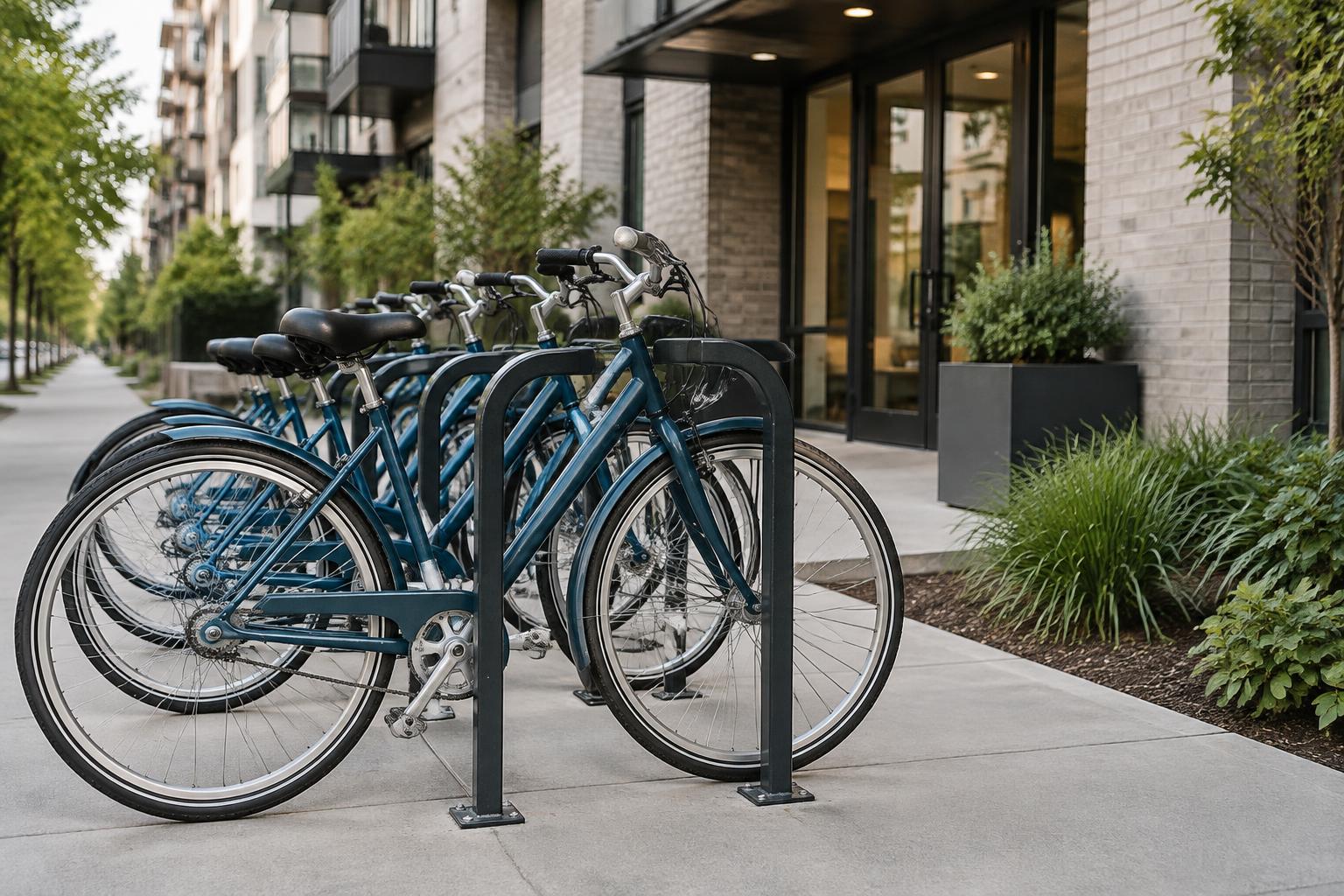
Suitable existing bike racks can often be reused for Property Pedal's fleet, which may reduce setup costs. Confirm suitability and the space allocation before treating that reuse as part of the proposal.
Check rack condition, current use, and the proposed fleet footprint. Retain space needed for residents' personal bicycles rather than assuming an occupied rack is available for shared bikes.
For this parking assessment, also record whether the proposed installation occupies any vehicle stalls. Show that change separately: installing bikes within existing parking capacity must not disappear from the comparison of available spaces.
The bike share for property managers overview explains the managed offering. Request a property-specific scope rather than relying on generic hardware prices or comparisons with unrelated systems.
How does geofencing keep the property organized?
Property Pedal uses designated pickup and return spaces that can be geofenced to suit the property. This hybrid model is neither unrestricted leave-anywhere riding nor a requirement to install proprietary docks.
Mark the proposed spaces on the same plan used for the parking assessment. Show the bicycle footprint separately from vehicle stalls, pedestrian routes, and loading areas so the physical allocation is clear.
Geofencing does not establish that every return will be orderly or that an app will block a session, impose a fee, or verify a bicycle's physical return. Confirm the actual return instructions and exception process with the provider rather than adding those capabilities to the parking proposal.
Frequently asked questions
Does geofencing keep shared bikes out of vehicle stalls?
Geofencing can define designated pickup and return spaces, but it does not guarantee that bikes remain outside vehicle stalls or circulation areas. Use a marked physical layout and confirmed resident instructions rather than treating a digital boundary as an enforcement promise.
If incorrectly parked bicycles are a concern, ask how residents should report them and how the proposed service handles that situation. Do not assume automatic penalties or location-based return verification.
Is the fleet in this parking proposal electric or standard?
Property Pedal supplies standard non-electric bicycles. Assess the intended trips on that basis rather than assuming electric assistance.
Public city systems may offer e-bikes, but they are separate third-party operations. The standard-bike description does not determine what permits or other site approvals may apply to a particular installation.
Can resident charges fund a parking-focused bike-share proposal?
Ask the provider to confirm whether the proposed configuration supports free access, per-use billing, or monthly memberships before selecting an arrangement. Do not present those options as confirmed Property Pedal software features or include assumed resident revenue in the proposal.
Request written details about any proposed charges and responsibility for payment questions. Whatever arrangement is confirmed, payment activity would not demonstrate that fewer residential vehicle stalls are needed.
What should the parking team know about a missing shared bike?
Property Pedal tracks the rider's phone location during rides. That fact does not establish retained route records, bicycle-mounted GPS, or a guaranteed recovery process.
Confirm the missing-equipment procedure and the appropriate contact in the proposed agreement. Keep a missing bicycle separate from vehicle-parking findings; phone tracking is not a record of how many resident cars occupy the garage.
How should you act on apartment parking pressure and bike share findings?
Recommend a parking-focused trial only when the shortage is documented, the proposed mechanism addresses vehicle-storage demand, and the team can collect relevant evidence. Otherwise, evaluate shared bikes as an amenity or defer the parking claim rather than promising freed stalls.
Send regional management a short recommendation with:
- The location and timing of the documented shortage.
- Available-stall and parked-vehicle observations, with known limitations.
- The household parking change being investigated.
- Evidence supporting that possibility and evidence still missing.
- Any vehicle capacity occupied by the proposed bike installation.
- The comparison conditions and findings that would support or contradict the parking case.
A defensible apartment parking pressure and bike share assessment can conclude that the amenity is useful while parking relief remains unproven. Keep that distinction visible instead of allowing ride totals to answer a different question.
For program context, review how it works. To discuss a property-specific fleet and service scope, request a quote with your parking observations and proposed pickup and return areas.